
Semester GPA Explained; what is semester gpa and how to calculate it
You check your results. You see a number. You have no idea if it's good, bad, or somewhere in the terrifying middle.
Semester GPA is one of those things every student encounters every few months, yet most people never really learn what it measures, how it connects to the bigger picture, or what a difference it actually makes. That changes today.
This guide covers semester GPA from the ground up: what it means, how it predicts your cumulative grade point average, the exact steps to calculate it, and the real difference between weighted GPA and unweighted GPA. Everything here comes from verifiable sources. No padding, no guesswork.
What Is Meant by Semester GPA?
Semester GPA is the weighted average of all the grades you earned in a single semester, expressed as a number on a 4.0 scale.
Each course you take has two things attached to it: a grade and a credit hour value. Semester GPA combines both into one number that tells you, and everyone reviewing your record, how you performed during that specific term.
It's a snapshot, not the full story. Think of it like a quarterly earnings report. It matters, but one bad quarter doesn't define the company. One rough semester doesn't define your academic record.
How Does the US GPA Scale Work?
In the United States, the standard GPA scale runs from 0.0 to 4.0. Each letter grade converts to a fixed point value. According to the National Center for Education Statistics (NCES), GPA is among the most consistently used academic evaluation metrics in American higher education.
Here's the full conversion table you'll find at most US universities:
|
Letter Grade |
Percentage Range |
GPA Points |
Performance Level |
|
A |
93–100% |
4.0 |
Excellent |
|
A- |
90–92% |
3.7 |
Excellent |
|
B+ |
87–89% |
3.3 |
Good |
|
B |
83–86% |
3.0 |
Good |
|
B- |
80–82% |
2.7 |
Good |
|
C+ |
77–79% |
2.3 |
Average |
|
C |
73–76% |
2.0 |
Average |
|
D |
60–69% |
1.0 |
Below Average |
|
F |
Below 60% |
0.0 |
Failing |
What Counts as a Good Semester GPA?
Context determines everything here. A 3.0 semester GPA meets the minimum standard at most four-year universities in the US. Competitive graduate programs and merit scholarships typically expect 3.5 or above.
According to PrepScholar, Harvard's admitted students average around 3.9 GPA. State universities are more accessible, a 3.0 to 3.5 is competitive at many programs. The benchmark that matters most is the one tied to your specific goal: scholarship threshold, program minimum, or employer screening cutoff.
Why Does One Semester's GPA Matter So Much?
Because semesters stack. Every semester GPA feeds directly into your cumulative grade point average. Start strong and you build a cushion. Start weak and you spend three semesters climbing back.
The math isn't forgiving, we'll show exactly why in the next section.
How Semester GPA Predicts Your Cumulative Grade Point Average
Your cumulative GPA is not a fresh calculation each semester. It's a running average that carries every semester's weight forward, which means early semesters punch above their own weight.
Here's an example that illustrates the math honestly.
Say you complete your first semester with a 2.5 GPA across 15 credit hours. Second semester, you work harder and earn a 3.7 across another 15 hours. Your cumulative GPA after two semesters isn't 3.7, it's 3.1. The 2.5 dragged the average down and it takes real effort to lift it back.
Now flip it. First semester: 3.8. Second semester: 3.0. Cumulative after two semesters: 3.4. Much easier territory to maintain a strong record from.
This is why academic advisors at every university repeat the same advice: your first two semesters carry disproportionate weight. It's not a lecture, it's arithmetic.
The Compounding Effect: What the Numbers Show
Research from the National Center for Education Statistics confirms that first-year college GPA is one of the strongest predictors of eventual graduation and academic success. Students who finish their first year below a 2.0 GPA face significantly higher dropout rates.
On the positive side, a student who earns a 3.8 in their first semester sets a baseline that's genuinely hard to destroy, even a 2.5 semester later only brings them down to around 3.15 cumulative, assuming equal credit loads. The cushion is real.
Can You Recover From a Low Semester GPA?
Yes, but it takes longer than people expect. If you're sitting at a 2.3 cumulative GPA after 30 credit hours, you'd need to average a 3.7 for the next 30 hours just to reach a 3.0 overall. That's two near-perfect semesters to undo the damage from two weak ones.
The lesson: a strong semester GPA isn't just a nice number on a portal. It's leverage — and you spend it or save it whether you mean to or not.
How to Calculate Your GPA: A Clear Step-by-Step Guide
Formula: GPA = Total Quality Points ÷ Total Credit Hours
That's it. The formula isn't complicated. What trips people up is not understanding what quality points are. Here's the full process.
Step 1 — Gather Your Course Information
For each course in the semester, you need:
- The course name (for your own reference)
- The number of credit hours assigned to that course
- The letter grade you earned
Step 2 — Convert Grades to Grade Points
Use the standard US grade scale (see table above). An A is 4.0, a B+ is 3.3, and so on. If your institution uses plus/minus grades, make sure you're using the right breakdown.
Step 3 — Calculate Quality Points for Each Course
Multiply each course's grade points by its credit hours.
Quality Points = Grade Points × Credit Hours
A 4-credit course with an A earns 4 × 4.0 = 16 quality points. A 3-credit course with a B earns 3 × 3.0 = 9 quality points. Straightforward.
Step 4 — Work Through a Real Example
Here's a complete semester with five courses,
|
Course |
Credits |
Grade |
Grade Points |
Quality Points |
|
Calculus II |
4 |
A |
4.0 |
16.0 |
|
English Composition |
3 |
B+ |
3.3 |
9.9 |
|
Intro to Economics |
3 |
B |
3.0 |
9.0 |
|
Chemistry Lab |
2 |
A- |
3.7 |
7.4 |
|
History of Civilization |
3 |
C+ |
2.3 |
6.9 |
|
TOTAL |
15 |
— |
— |
49.2 |
Quality points = Grade Points × Credit Hours for each course.
Step 5 — Divide and Get Your GPA
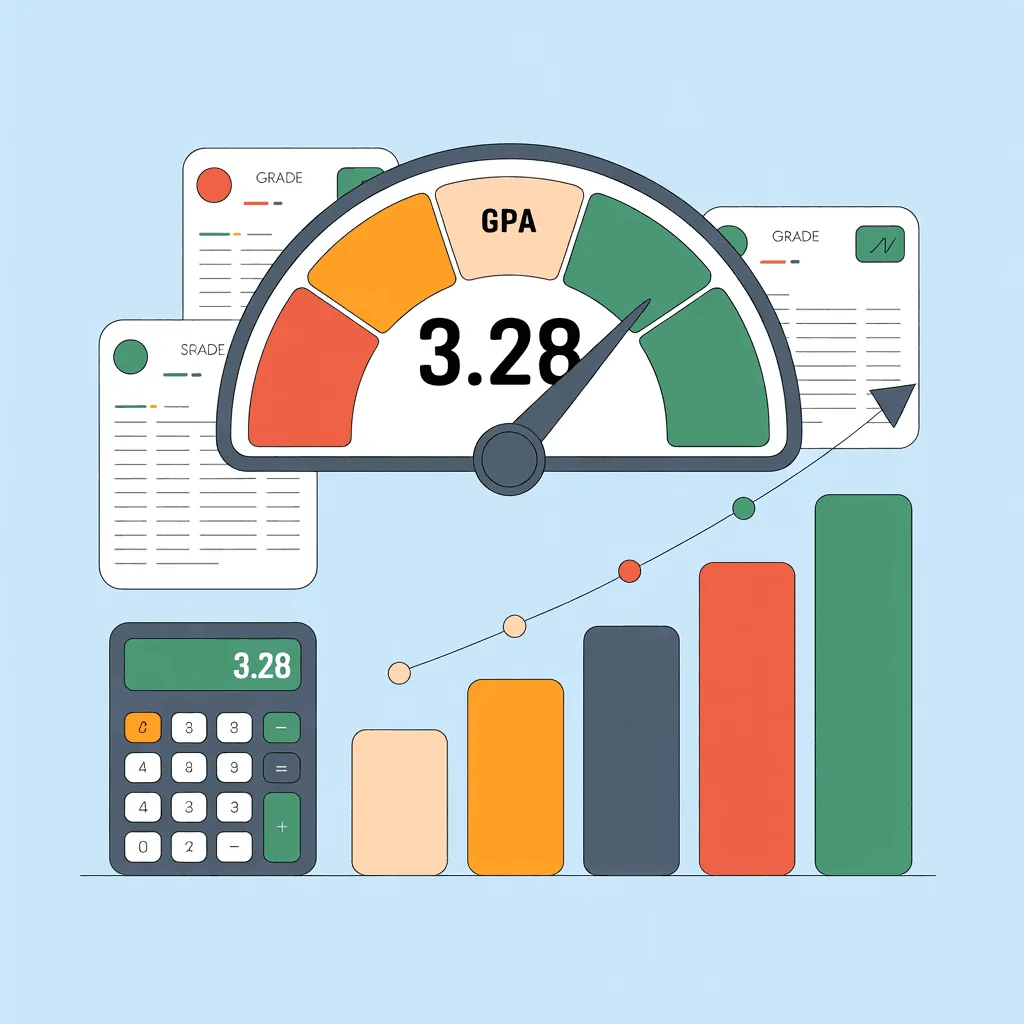
49.2 ÷ 15 = 3.28 Semester GPA
That's the number that appears on your transcript at the end of the term. Your institution calculates this automatically, but knowing the math lets you predict your GPA before results are published, which is genuinely useful if you're tracking scholarship eligibility.
What About Mid-Semester Projections?
You can run this calculation any time, even before finals, using your current grades. It won't be exact, but it gives you a realistic target. If you're sitting at 3.1 going into finals and need a 3.5 semester GPA to keep a scholarship, you can work out exactly what grades you need in each remaining exam.
That's not cheating the system. That's using numbers intelligently.
What Is the Difference Between Weighted GPA and Unweighted GPA?
Unweighted GPA treats every course the same. Weighted GPA rewards you for taking harder ones.
This distinction matters most in high school, where students can choose between standard, honors, and AP (Advanced Placement) courses. But it also applies in some undergraduate programs and international academic systems.
Unweighted GPA: The Level Playing Field
An unweighted GPA tops out at 4.0. It doesn't care whether you took AP Physics or an easier elective. An A is a 4.0 either way.
This makes it consistent across institutions. A 3.6 unweighted GPA from one school means the same thing as a 3.6 from another. That's why most scholarship committees and graduate programs use unweighted GPA as their benchmark, it's a clean, comparable number.
Weighted GPA: The Rigor Reward
A weighted GPA adds bonus grade points for advanced courses. The standard addition is +1.0 for AP or honors-level classes. So an A in an AP course earns 5.0 points instead of 4.0. A B earns 4.0 instead of 3.0.
The result is that a student who challenges themselves academically can finish with a weighted GPA above 4.0, sometimes as high as 4.5 or 4.8 depending on their course load. According to College Board, weighted GPA systems using the 5.0 scale are used by a significant portion of US high schools.
|
Factor |
Weighted GPA |
Unweighted GPA |
|
Scale |
4.0 or 5.0 |
4.0 |
|
Course difficulty |
Factored in |
Ignored |
|
AP/Honors bonus |
Yes (+1.0 per grade) |
No |
|
Can exceed 4.0 |
Yes (on 5.0 scale) |
Never |
|
Cross-school compare |
Harder |
Easier |
|
Used by |
Schools internally |
Admissions & scholarships |
Which One Do Admissions Offices Actually Use?
Both, and they know the difference. According to PrepScholar, most selective US colleges recalculate applicants' GPAs on their own unweighted scale during the review process. A 4.3 weighted GPA gets normalized back to roughly 3.7 or 3.8 depending on the courses taken.
The weighted number still matters because it signals ambition and academic risk-taking. But the courses themselves, visible on your transcript, tell that story more clearly than the inflated number alone.
For International Students: Which GPA Format Should You Submit?
Submit whatever your official transcript shows. If your institution reports CGPA on a 4.0 scale, use that. If you have a percentage-based result, convert it using the WES iGPA Calculator at wes.org, it's free and covers grades from over 100 countries.
For Pakistani students: 80–100% typically converts to 3.6–4.0 on the US scale. 70–79% maps to roughly 3.0–3.5. Always verify with WES for official applications. Self-converted numbers are fine for research; scholarship submissions need a verified evaluation.
Frequently Asked Questions
Q1: Is semester GPA the same as cumulative GPA?
No. Semester GPA covers only the current term. Cumulative GPA (CGPA) is the running average across every semester you've completed. Most applications, scholarships, and employment screenings ask for your cumulative GPA.
Q2: What GPA do I need to keep my scholarship?
It depends on the scholarship. Most US merit scholarships require a minimum cumulative GPA between 3.0 and 3.5. Prestige awards like Fulbright expect 3.7 or above from competitive applicants. Always check the specific requirements, they're listed in the scholarship's eligibility section, not in the headline.
Q3: Can I raise my GPA in one semester?
You can improve it, but the change depends on how many credit hours you've already completed. Earlier in your degree, one strong semester moves the needle significantly. Later, with 90+ credit hours banked, a single semester has less impact. The math is honest: the more hours behind you, the harder it is to shift the cumulative average.
Q4: Does a weighted GPA above 4.0 help my college application?
It helps signal that you took challenging courses, but admissions officers know how to read it. Most selective colleges recalculate your GPA on their own unweighted scale anyway. The courses on your transcript carry more weight than the inflated number. Pursue rigorous courses because they prepare you better, not just because of the GPA bump.
Q5: Do employers care about semester GPA or cumulative GPA?
Cumulative GPA. A 2022 NACE survey found that 56% of employers screen entry-level applicants by GPA, with 3.0 as the most common threshold. Finance, consulting, and engineering firms often set it at 3.5. Individual semester performance doesn't appear on most resumes, your CGPA is the number that matters.
Q6: What is the fastest way to calculate GPA without doing it manually?
Use your institution's student portal, most publish your GPA automatically after grades post. For projections before results are finalized, a GPA calculator on sites like CollegeSimply or GPA Calculator gives accurate results if you enter your grades and credit hours correctly.
Q7: Is a 3.0 GPA actually good?
A 3.0 GPA is the baseline, it meets the minimum standard for most university programs, entry-level jobs, and general scholarship eligibility. It's not exceptional, but it's not weak either. Where it lands on the spectrum depends entirely on what you're applying for. For Ivy League graduate programs: low. For most state university programs: fine. For most jobs: acceptable. Context is everything.
My Personal Take on GPA
GPA is useful. It's also overrated, and those two things aren't contradictory.
Here's what I think after looking at how GPA actually functions in academic systems, scholarship decisions, and hiring processes: it's a signal, not a verdict. A strong GPA tells reviewers you showed up consistently and met the expectations of your academic environment. That's real. Discipline and consistency are genuine qualities worth recognizing.
A lower GPA doesn't mean you're less capable. It might mean you worked while studying. It might mean you took harder courses and paid the price on paper. It might mean one semester went sideways for reasons that had nothing to do with your intelligence.
What I find more interesting than the GPA debate is how students respond to it. Some students treat a 2.8 like a permanent identity. It's not. Others treat a 4.0 like it guarantees everything. It doesn't, ask anyone who graduated with honors and then froze in their first job interview.
The students who seem to navigate this best are the ones who treat GPA as one input among many. They track it, they work to improve it, and they also build skills, experiences, and relationships that no transcript can capture.
So yes, work hard for a strong semester GPA. Understand how it compounds into your CGPA. Know the thresholds that matter for what you're building toward. And then remember that the number describes your past performance, not your future ceiling.
Calculate it. Manage it. Don't let it manage you.